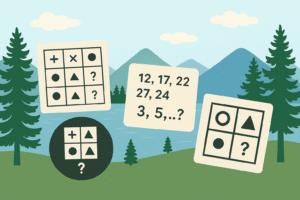

The P&G online assessment is a key screening step for most graduate and office roles in areas such as marketing, finance, supply chain and engineering. For these roles, candidates usually complete two main tests: the PEAK Performance Assessment and the P&G Interactive Assessment, which includes the well known Digit, Switch and Grid challenges. This guide explains what each test looks like, how scoring works and how you can prepare effectively.
What the P&G Online Assessment Includes
P&G uses a combination of behavioural and game based assessments to identify candidates whose skills and values match the company. For most office roles, the online assessment stage has two core parts:
- PEAK Performance Assessment. A behavioural and situational judgement test that checks how your values, decisions and work style align with P&G’s culture.
- P&G Interactive Assessment. A set of short, game based cognitive tests that measure numerical reasoning, logical thinking, memory and multitasking.
The PEAK Performance Assessment usually takes around 20 minutes. It contains several sections that cover your background, previous experiences and the way you typically respond at work. The Interactive Assessment is delivered as a series of short challenges and typically lasts around 30 minutes in total.
In addition, some experienced hire roles, especially in sales, include a Sales Virtual Job Preview, which is a longer simulation with multiple exercises. This guide focuses on the PEAK Performance and Interactive assessments, because these are the tests most graduates and students encounter.
P&G Values and PEAK Factors
The PEAK Performance Assessment is built around P&G’s Purpose, Values and Principles and a set of PEAK factors such as leading with courage, innovating for growth and executing with excellence. When you answer the questions, P&G checks how strongly your profile reflects these factors, not just whether your answers look impressive on the surface.
Why the Online Assessment Matters
The online assessment filters a large percentage of applicants before interviews. Many candidates report that the cognitive games feel surprisingly challenging once the difficulty increases. Approaching the tests without preparation can reduce your chance of reaching the next stage, which is why understanding the format in advance is so valuable.
PEAK Performance Assessment: Format and Example Questions
The PEAK Performance Assessment is a mixed format test that blends situational judgement with work style questions. Most candidates complete it in around 20 minutes, although it is not heavily time pressured. Once you start, you need to complete all sections before you can move on in the process.
Typical Sections in PEAK Performance
The exact mix of questions can vary by role, however a common structure includes:
- Background and experience items. Multiple choice questions about your work history or study projects.
- Situational judgement questions. Short scenarios where you rank possible responses from most to least effective.
- Work style ratings. Statements about how you prefer to work, which you rate on a scale such as strongly agree to strongly disagree.
- Culture fit questions. Items that check how closely your values match P&G’s Purpose, Values and Principles.
Many candidates experience PEAK Performance as a blend of personality questionnaire and SJT style test. The important part is that your answers form a clear, consistent pattern that fits how P&G expects people to behave.
You are an intern in a P&G brand team that is preparing a tight deadline presentation for a retailer. A colleague notices an error in the sales data that will take extra time to correct. If you correct the error, the slides may be slightly less polished. If you ignore it, the numbers in the deck will be inaccurate. You are asked what you would do.
Rank the options from 1 (most effective) to 4 (least effective).
- A. Leave the numbers as they are because the team has already approved them and focus on visual quality.
- B. Correct the error, explain the impact to the team and update the slides, even if some design details stay rough.
- C. Ask another intern to decide what to do and follow their suggestion so you do not slow the team down.
- D. Wait until your manager is free, even if that means you might miss the internal deadline.
Suggested ranking: B, D, A, C
Explanation
Option B reflects integrity, ownership and a focus on accurate business decisions, which align with P&G’s values. Option D shows concern for quality but introduces unnecessary delay. Option A sacrifices accuracy for presentation polish, which conflicts with the idea of executing with excellence. Option C avoids responsibility and does not match the ownership P&G expects.
In the PEAK Performance Assessment you also see rating style questions such as:
For each statement, choose how strongly it describes you.
- I like to take initiative when I see an opportunity to improve a process.
- I enjoy working with data to support my recommendations.
- I remain focused and calm when several tasks compete for my attention.
How to approach it
Explanation
There are no right answers in the traditional sense, however the system checks whether your pattern of responses matches the PEAK factors. A candidate who frequently selects options that show ownership, curiosity and resilience will usually have a stronger fit than someone who indicates low initiative or discomfort with responsibility.
Interactive Assessment: Digit, Switch and Grid Challenges
After PEAK Performance, many candidates are asked to complete the P&G Interactive Assessment. This is a set of gamified tests delivered through Aon’s SmartPredict platform. The three games measure:
- Digit Challenge – numerical reasoning and mental arithmetic.
- Switch Challenge – logical deductive reasoning and short term memory.
- Grid Challenge – working memory and spatial orientation.
Together, the games take around 25 to 30 minutes. Each test is adaptive, which means that questions become harder when you answer correctly and easier when you answer incorrectly. Higher difficulty questions are worth more points, so strong performance early in the test matters.
Digit Challenge
In the Digit Challenge you complete equations or number patterns as quickly and accurately as possible. You usually have around 5 to 6 minutes to solve as many tasks as you can, and you can only use each number once in a given equation. Later questions often combine more than one rule, which is why practising harder patterns in advance is useful.
Find the number that should replace the question mark.
2, 5, 11, 23, 47, ?
- A. 92
- B. 93
- C. 95
- D. 99
Answer: C
Explanation
Each term is multiplied by two and then increased by one. 2 × 2 + 1 = 5, 5 × 2 + 1 = 11, 11 × 2 + 1 = 23, 23 × 2 + 1 = 47, so the next term is 47 × 2 + 1 = 95. In the real test, patterns can change mid sequence or combine several rules, so this question is still a simplified example.
Switch Challenge
The Switch Challenge is a six minute deductive reasoning test. You see a row of four symbols at the top and a row of four symbols at the bottom. Between them are one or more blue “switch” operators that reorder the symbols. Each operator is labelled with a sequence of four numbers that describes how positions are permuted. Your task is to choose which operator, or sequence of operators, transforms the top row into the bottom row.
On higher levels, the game uses two or three operators in a row, which forces you to hold several transformations in short term memory and mentally track how they combine.
The numbers 1 to 4 refer to the original positions of the top row, from left to right. For example, 2 4 1 3 would mean: second symbol first, fourth symbol second, first symbol third, third symbol last.
Which operator (A, B or C) matches the transformation shown above?
- A. Operator A
- B. Operator B
- C. Operator C
Answer: A
Explanation
Label the top row symbols as positions 1 to 4. Top row: 1 = orange square, 2 = green circle, 3 = blue circle, 4 = red square. Bottom row: green circle, red square, orange square, blue circle. To get this order from the original row, you need 2, 4, 1, 3. That is exactly the sequence for operator A, so A is correct. In the real Switch Challenge you often apply two or three operators in sequence, which quickly overloads short term memory if you are not used to tracking several permutations at once.
Grid Challenge
The Grid Challenge is a nine to twelve minute game that combines working memory with spatial reasoning. Each round alternates between two types of tasks:
- Memory phase – you see a blue grid where one dot lights up at a time. You must remember the locations and the order in which the dots appear.
- Spatial phase – you are briefly shown a different grid task, such as deciding whether a pattern is symmetric, whether two shapes match, or how a shape looks after rotation.
After three to five alternations between dots and spatial questions, you are asked to click the grid cells in the exact order the dots appeared. Difficulty increases by adding more dots, larger grids and harder spatial questions. The test is adaptive, so accurate performance quickly pushes you to challenging levels.
Below is a simplified static version of what one round can feel like. In the real game the screens appear one after another with a timer at the top.
What you would do
Explanation
In the first card you memorise the dot sequence, in this case R1C2 followed by R3C4. In the second card you quickly answer the symmetry question, which distracts your attention. In the third card you must still recall the original order of dots and click those cells correctly. In the real Grid Challenge there are more dots, more rounds and harder spatial questions, and everything is timed, so practising under pressure is essential if you want a strong score.
Tips for Passing the P&G Online Assessment
- Study P&G’s values and PEAK factors. Read the culture pages on P&G Careers and keep those principles in mind during PEAK Performance questions.
- Answer consistently in PEAK Performance. The system looks for patterns in your behaviour across multiple items, not single heroic answers.
- Use targeted practice for the games. Practice short number series, logic puzzles and memory tasks to prepare for Digit, Switch and Grid. Harder questions reveal your weak spots early.
- Work under time pressure. Set short timers when you practise. The games reward quick yet accurate decisions.
- Read instructions carefully on each game. P&G and their test provider include clear instructions at the start of each challenge. Misunderstanding the rules is one of the most common reasons candidates underperform.
FAQ
For most roles, PEAK Performance takes around 20 minutes and the Interactive Assessment adds about 25 to 30 minutes, so you should set aside at least one hour in a quiet environment.
Many candidates find the assessment demanding, mainly because the games are adaptive and the PEAK Performance questions require careful judgement. With focused practice and an understanding of the format, the difficulty becomes more manageable.
You cannot memorise answers, but you can prepare by reviewing P&G’s values, reflecting on your own experiences and practising situational judgement style questions. The goal is to respond honestly while keeping P&G’s culture in mind.
Not always. Some roles require only one or two of the games, while others include the full set. Your invitation email from P&G will specify which assessments you need to complete.
P&G does not publish detailed retake rules, however many candidates are told that they need to wait until the next recruiting cycle or a future application to retest. It is safest to assume that you only have one attempt for your current application.
Candidates who pass are usually invited to interviews or a virtual job preview that focuses on the specific function, such as sales or plant technician roles. These stages assess your technical knowledge and deeper behavioural fit.