
AON online assessment tests are used by employers around the world to screen candidates before interviews take place. These tests decide very quickly whether you move forward or get rejected, especially for graduate schemes, internships, and high volume early career roles.
AON, sometimes still called cut e in older materials, provides a full battery of cognitive, behavioural, and personality tests. Employers combine them into a custom assessment that matches the skills and traits they want for a specific role. If you understand what each AON test is really measuring, and how the scoring works, you can prepare in a focused way rather than guessing.
In this guide, you will learn what AON assessments are, which test types you are likely to face, what they are actually testing beneath the surface, how scoring and benchmarking work, and how to prepare step by step so that you score above the cut off.
What Are AON Online Assessments?
AON is a global professional services firm that provides talent assessment tools to employers. Under the AON assessment brand, companies receive a modular set of tests that they can plug into their recruitment process. These tests measure cognitive ability, work related behaviour, and personality traits that have been shown to predict performance.
Historically, these assessments were known as cut e tests. Many candidates still search online using both names. If you see an employer mention AON assessments, cut e tests, or AON cut e, they are referring to the same family of online assessments.
For you as a candidate, the important point is simple. AON assessments are not a minor formality. They are a central decision tool for employers, and your score is often used as an elimination filter before any human reviewer sees your application in detail.
Where You Will See AON Tests in Recruitment
AON assessments are used across many sectors, including banking, insurance, consulting, engineering, technology, and consumer goods. You are most likely to encounter them in graduate schemes, internship processes, and early career programmes where thousands of candidates apply each year.
Most employers place the AON assessment at one of the following stages.
- Immediately after you submit your online application.
- After an initial CV screen, as a second filter before interviews.
- As part of an assessment center that also includes interviews and group tasks.
Because the assessment is often completed before any interview, it frequently has more weight in the decision than candidates expect. A strong assessment score can rescue a slightly weaker CV, but a weak assessment score can undo an otherwise strong profile.
Overview of the AON Test Battery
AON does not offer a single generic test. Instead, it provides a collection of test modules. Employers combine these into a custom assessment route that matches the skills they want to measure.
Common AON modules you might see include the following.
- Numerical reasoning tests that involve charts, tables, and business data.
- Verbal reasoning tests that measure comprehension and critical reading.
- Logical or inductive reasoning tests that involve abstract shapes and patterns.
- Situational judgement tests that present realistic work scenarios.
- Personality and motivation questionnaires that explore behavioural preferences.
Some employers also add more specialised modules such as spatial reasoning or mechanical reasoning, especially for technical and engineering roles.
AON Numerical Reasoning Test
The AON numerical reasoning test measures how well you interpret numerical information and use it to make correct decisions. You will usually see short business themed scenarios with accompanying tables, charts, or graphs. Each question requires a calculation, often involving percentages, ratios, currency conversions, or growth rates.
The mathematics itself is not advanced, but the time limits are strict. The test is designed to see how accurately you can work under pressure while still understanding the context of the question.
A retailer sells two product lines, A and B, over three years.
- Year 1: Product A, €1.8 million, Product B, €2.4 million
- Year 2: Product A, €2.1 million, Product B, €2.7 million
- Year 3: Product A, €2.5 million, Product B, €3.0 million
In Year 1, the total profit margin across both products is 25 percent. In Year 3, the profit margin on Product A increases by 4 percentage points compared to Year 1, and the profit margin on Product B decreases by 2 percentage points compared to Year 1.
What is the approximate total profit (in euros) across both products in Year 3?
- A. €1.31 million
- B. €1.44 million
- C. €1.53 million
- D. €1.62 million
Answer: B
Explanation
In Year 1, the combined revenue is €1.8 million plus €2.4 million, which equals €4.2 million. A 25 percent profit margin means profit of €4.2 million multiplied by 0.25, which equals €1.05 million.
The problem states that, compared to Year 1, in Year 3 the margin on Product A increases by 4 percentage points and the margin on Product B decreases by 2 percentage points. If the total margin in Year 1 is 25 percent and we assume this is an average of the two products, then one simple way to model the change is to keep the overall combined margin roughly similar and focus on the new weighted margins. For an approximate approach, treat the base margin per product as 25 percent, so Product A in Year 3 is at 29 percent and Product B is at 23 percent.
In Year 3, revenue from Product A is €2.5 million with a 29 percent margin. Profit from Product A is therefore €2.5 million multiplied by 0.29, which equals €0.725 million. Revenue from Product B is €3.0 million with a 23 percent margin. Profit from Product B is €3.0 million multiplied by 0.23, which equals €0.69 million.
Combined profit in Year 3 is approximately €0.725 million plus €0.69 million, which equals €1.415 million. The closest option is €1.44 million.
This type of question combines reading, proportional reasoning, and multi step calculation. Working with rounded numbers and approximate methods is an important part of managing the time pressure in the real test.
AON Verbal Reasoning Test
The AON verbal reasoning test measures how accurately you can understand and evaluate written information. You will see a short text passage followed by one or more statements. Your task is to decide whether each statement is true, false, or whether you cannot say based only on the passage.
The key rule is that you must not bring in outside knowledge or assumptions. The only information that matters is the text in front of you. This is harder than it sounds, particularly when passages describe familiar topics such as economics or technology.
Passage: A logistics company introduced a new routing algorithm to optimise delivery times in urban areas. During a six month trial, average delivery time fell by 12 percent in cities where the algorithm was used. However, overall customer satisfaction scores did not change significantly during the same period. The company s management suspects that factors such as driver behaviour and communication with customers may have a stronger impact on satisfaction than small changes in delivery time.
Statement 1: The trial proved that the new routing algorithm has no effect on customer satisfaction.
Statement 2: The company believes that improving how drivers interact with customers might increase satisfaction more than further reducing delivery times.
- A. Statement 1 is true and Statement 2 is true.
- B. Statement 1 is true and Statement 2 is false.
- C. Statement 1 is false and Statement 2 is true.
- D. Statement 1 is false and Statement 2 cannot be determined from the passage.
Answer: C
Explanation
For Statement 1, the passage says that average delivery time fell by 12 percent, but that overall customer satisfaction scores did not change significantly. This tells you that satisfaction did not move much during the trial period, but it does not prove that the algorithm has no effect at all. There might be other factors masking a small effect. Therefore, Statement 1 is too strong and is false.
For Statement 2, the passage explicitly states that management suspects factors such as driver behaviour and communication may have a stronger impact on satisfaction than small changes in delivery time. This is equivalent to saying that they believe improving how drivers interact with customers might increase satisfaction more than further reducing delivery times. Therefore, Statement 2 is true.
The only option that matches these conclusions is option C, Statement 1 is false and Statement 2 is true.
Verbal reasoning items often hinge on how carefully you evaluate the strength of claims. Words such as prove, always, never, and stronger impact are commonly used to test whether you are reading precisely.
AON Logical and Inductive Reasoning Tests
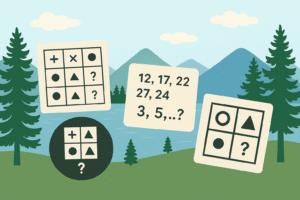
AON logical or inductive reasoning tests use abstract shapes, patterns, and sequences rather than words or numbers. You might be given a grid of figures and asked which option completes the pattern, or a sequence of shapes where you must choose the next item in the series.
These tests are designed to measure fluid intelligence, which is your ability to recognise structure in new information. They do not rely on specific prior knowledge.
You see a row of four frames. Each frame contains a circle and a triangle.
- In Frame 1, the circle is on the left, shaded, and the triangle is on the right, not shaded.
- In Frame 2, the circle is on the right, not shaded, and the triangle is on the left, shaded.
- In Frame 3, the circle is on the left, shaded with a border, and the triangle is on the right, shaded.
The same two rules apply throughout the sequence.
- Rule 1: From one frame to the next, the circle and triangle swap positions.
- Rule 2: Whenever a shape that was previously shaded and on the left moves to the right in the next frame, it becomes not shaded with a border.
Which option best completes Frame 4?
- A. Circle on the right, shaded, triangle on the left, not shaded.
- B. Circle on the right, not shaded with border, triangle on the left, shaded.
- C. Circle on the right, shaded with border, triangle on the left, not shaded.
- D. Circle on the right, not shaded, triangle on the left, not shaded with border.
Answer: B
Explanation
Apply Rule 1 first. From Frame 3 to Frame 4, the circle and triangle must swap positions. In Frame 3, the circle is on the left and the triangle is on the right, so in Frame 4 the circle must be on the right and the triangle on the left. This immediately rules out any option where this is not the case.
Now apply Rule 2. In Frame 3, the circle is on the left, shaded with a border. When it moves to the right in the next frame, it should become not shaded with a border. Therefore, in Frame 4, the circle on the right must be not shaded with a border.
The triangle in Frame 3 is on the right and shaded. When it moves left in Frame 4, Rule 2 does not apply, because the rule only references shapes that were shaded and on the left before moving right. The triangle therefore remains shaded when it appears on the left in Frame 4.
The only option that has the circle on the right, not shaded with a border, and the triangle on the left, shaded, is option B.
Real AON items use visual grids rather than text descriptions, but they follow a similar idea. Multiple rules operate at the same time, and your task is to work out how they interact across the sequence.
AON Situational Judgement Tests
AON situational judgement tests, often called SJTs, present you with realistic workplace scenarios. Each scenario describes a situation you could face in the role, and gives several possible responses. You need to choose the most effective and sometimes the least effective response.
SJTs measure how you balance priorities, work with others, handle conflict, and respond under pressure. They are less about speed and more about judgement and consistency with the employer s values.
You are a junior analyst working on a time critical project for an important client. Your manager is travelling and has limited availability. Early in the afternoon, a senior stakeholder from another department emails you directly asking for an updated version of a slide deck that your team is still revising. They want to use it in a meeting that starts in 45 minutes. The latest version of the deck contains some tentative figures that have not yet been fully checked.
What is the most appropriate response?
- A. Send the current version of the deck immediately, explaining that some figures may still change.
- B. Refuse to send the deck and tell the stakeholder to wait until your manager is back.
- C. Call or message the stakeholder, explain the status of the deck, and agree on which parts can safely be shared in time.
- D. Edit the deck quickly yourself to remove anything you are unsure about, then send your revised version without informing anyone.
Most effective response: C
Explanation
Option A prioritises speed but risks sharing unverified figures that could damage credibility if they are wrong. Option B protects accuracy but is unhelpful and inflexible, and escalates the issue unnecessarily. Option D takes unilateral action on content that you may not fully understand, and removes information without consultation.
Option C balances risk and collaboration. You contact the stakeholder directly, provide transparency about the status of the deck, and work together to decide what can be used safely in their meeting. This shows ownership, judgement, and respect for both data quality and the stakeholder s time constraints.
AON Personality and Motivation Questionnaires
Many AON assessment routes include personality or motivation questionnaires. These are not tests in the traditional sense because there are no right or wrong answers, but they are still used in hiring decisions.
You will see a series of statements such as I prefer to plan my work in detail or I enjoy taking the lead in group situations, and you will rate how strongly you agree or disagree. The questionnaire then builds a profile of your preferred ways of working, typical behaviours, and what motivates you.
Employers use these profiles to see whether your natural style fits the demands of the role. For example, a sales role might require high levels of persistence and sociability, while a risk management role might emphasise attention to detail and cautious decision making.
The most important thing in personality questionnaires is consistency. If you try to game the system by guessing what the employer wants, your answers may become contradictory. Many modern questionnaires include validity checks that flag inconsistent or extreme responses.
What AON Tests Really Measure
On the surface, AON assessments ask you to solve problems, read passages, interpret charts, or choose responses to scenarios. Beneath that surface, the tests are designed to measure underlying psychological constructs that correlate with performance in many jobs.
- General mental ability: The capacity to learn quickly, reason with new information, and adapt to unfamiliar problems.
- Working with numbers and data: The ability to accurately interpret numerical information and draw correct conclusions.
- Critical reading and verbal analysis: The skill of extracting relevant meaning from complex written material.
- Abstract reasoning: Pattern recognition and structural thinking that support problem solving in new domains.
- Judgement in social situations: How you balance competing priorities and deal with colleagues, clients, and managers.
- Behavioural style and motivation: The preferences that shape how you work day to day, including teamwork, leadership, and resilience.
Employers use AON test scores to estimate how strongly you display these constructs compared to other candidates and sometimes compared to existing high performers within the company.
How AON Scoring, Norms, and Benchmarking Work
AON assessments rarely use a simple pass or fail mark like 70 percent correct. Instead, your results are usually converted into standard scores or percentiles relative to a comparison group.
A percentile tells you what proportion of the comparison group scored below you. For example, if you are in the 75th percentile, it means you scored better than roughly 75 percent of the reference group. Employers can then set cut off levels such as only considering candidates who score at or above the median of the relevant norm group.
Norm groups might be based on the general population, on university graduates, or on previous applicants for the same role. Some employers even benchmark against their own top performers and aim to hire candidates whose profiles look similar.
In practice, this means that your goal is not just to reach a certain number of correct answers. Your goal is to perform better than a large proportion of other applicants. This is why targeted practice makes a real difference. Even a modest improvement in speed or accuracy can move you from below the cut off to safely above it.
Typical Candidate Experience and Test Conditions
When an employer invites you to complete an AON assessment, you will usually receive an email with a link, login details, and a deadline. Some tests are mobile friendly, but whenever possible you should use a laptop or desktop computer with a stable internet connection.
Before the scored test begins, many AON assessments provide a short tutorial with example questions. Use this to understand the interface and practice the controls. Once you start the actual timed section, the clock will usually continue even if your connection drops, so it is important to set up in a quiet and reliable environment.
Some tests allow you to move back and forth between questions, while others lock your answer before moving on. You might see a progress bar indicating how far you are through the test, but in some adaptive tests, items are shown one by one without a clear sense of overall progress.
Employers often receive a dashboard style report rather than the raw score. The report may show your performance on each test compared to the chosen norm group, highlight strengths and development areas, and flag any concerns about effort or consistency.
Common Mistakes Candidates Make on AON Assessments
After helping many candidates prepare for AON and similar assessments, several recurring mistakes show up again and again. Avoiding these puts you ahead of a large part of the field without any extra talent.
- Underestimating the time pressure. Many candidates skim through one or two sample questions, assume the test looks easy, and then run out of time in the real thing.
- Skipping basic practice. Even small amounts of targeted practice can refresh maths skills, sharpen reading habits, and train pattern recognition.
- Ignoring instructions. Some AON tests penalise incorrect answers while others do not, yet candidates often guess randomly without checking the rule.
- Trying to fake personality responses. Over editing your answers to look perfect can make your profile inconsistent or unrealistic.
- Practising the wrong format. Not all numerical or logical tests look the same, so it is important to focus on AON style questions and timing patterns.
- Leaving preparation until the last day. Spacing your practice over several days leads to better performance than cramming everything into the evening before the deadline.
How to Prepare for AON Tests Step by Step
Effective preparation for AON assessments is less about grinding hundreds of random questions and more about focused, deliberate practice. The steps below give you a practical structure you can follow in the days before your test.
Step 1: Identify the Exact Tests You Will Face
Re read your invitation email and note down the names of each test module. For example, numerical reasoning, verbal reasoning, logical reasoning, situational judgement, and personality questionnaire. This lets you allocate your time according to the tests that matter most for your role.
Step 2: Refresh the Core Skills
For numerical reasoning, revise percentages, ratios, basic algebra, and reading graphs. For verbal reasoning, practise reading short business passages and pulling out key facts. For logical reasoning, practise spotting patterns in shapes using resources that are visually similar to the AON style.
Step 3: Practise Under Realistic Time Limits
Set a timer and answer questions in small blocks that mirror the actual test length. This conditions you to make decisions at the right pace and avoids the shock of seeing the timer counting down during the real assessment.
Step 4: Analyse Your Mistakes
After each practice block, spend at least as long reviewing your mistakes as you spent doing the questions. Ask yourself whether you misread the question, used the wrong method, made a calculation slip, or simply ran out of time. Adjust your approach for the next block based on what you discover.
Step 5: Plan Your Test Day Environment
Choose a quiet location with reliable internet and a comfortable chair. Turn off notifications on your phone and computer. Have a notepad, pen, and if allowed, a basic calculator ready. Log in a few minutes early to avoid last minute stress.
Step 6: Prepare for the Stages After the Assessment
Many candidates treat the AON test as a separate hurdle, but employers look at your performance across the entire process. Use the reflection you gain from preparation to shape your interview answers too. For example, if numericals are a strength, prepare stories where you used data to influence decisions. If SJTs highlight your teamwork, prepare examples that show collaboration under pressure.
FAQ
AON assessments are challenging, but not impossible. The questions themselves are usually at a level that most graduates can handle, but the combination of time pressure, unfamiliar formats, and competitive benchmarking makes them feel tough. Focused preparation can move you from struggling to comfortably above the cut off for many roles.
Retake policies depend on the employer, not on AON itself. Some companies allow you to reapply in the next recruitment cycle and re take the assessments after a set period, for example six or twelve months. Others restrict retakes for longer. Always check the information provided by the employer for details about your specific process.
Some AON modules penalise incorrect answers while others do not. For example, certain adaptive tests focus on how quickly you answer correctly and may adjust difficulty based on your performance. The only safe approach is to read the instructions at the start of each test and follow the guidance given there. If negative marking applies, you should avoid random guessing and only answer when you can eliminate some options or make a reasoned choice.
No. AON offers a library of test modules, and each employer chooses which ones to include. They may also choose different difficulty levels or norm groups. This means that the overall experience can feel different from one company to another, even though the underlying test technology is the same. Your preparation should focus on the core skills that are common across employers, rather than trying to memorise any one company s version.
The exact duration depends on how many modules your employer has selected. A single numerical or verbal reasoning test might take around 15 to 20 minutes, a logical test another 15 minutes, and an SJT or personality questionnaire can add between 20 and 40 minutes. Many full AON assessment routes end up taking between 45 and 90 minutes in total, sometimes split into separate sessions.
Some AON tests are technically mobile compatible, but if you have the choice, it is much better to use a laptop or desktop computer. A larger screen makes it easier to read passages, view graphs, and compare answer options. Small screens increase eye strain and scrolling, which can slow you down or cause mistakes under time pressure.
Whether calculators are allowed depends on the specific test and the employer s policy. Some numerical tests allow a basic calculator, while others are designed to be completed using mental arithmetic and rough working on paper. The instructions at the beginning of the test will tell you clearly what is allowed. If calculators are permitted, use them sensibly for more complex calculations but do not rely on them as a substitute for understanding percentages and ratios.
Attempting to cheat is risky and usually short sighted. Some employers use webcam recording, screen monitoring tools, or follow up verification tests in person. Even if someone else helps you through the assessment, you may then be invited to complete a similar test at the assessment center where you cannot get help. If your performance drops suddenly, this can raise doubts about your integrity and suitability for the role. It is far better to invest time in genuine preparation and present your real ability confidently.
This again depends on the employer. Some organisations share feedback or a summary of your strengths and development points, especially if they use AON reports as part of development planning. Others do not share detailed scores and only inform you whether you passed to the next stage. If you are unsure, you can politely ask your recruiter whether high level feedback will be available once the process is complete.
A realistic and effective preparation window is usually between three days and two weeks, depending on your starting level and how many tests you need to complete. Even if your deadline is sooner, a focused day or two of practice can still help, but if you know that the companies you want to apply to use AON assessments, it is smart to begin practising core skills well before you even submit your applications.